
An aneurysm is a localised dilatation or swelling of an artery and can occur anywhere in the body
The most common site is in the aorta, which is the largest blood vessel in the body. Other common sites include the arteries in the legs such as popliteal (behind the knee), femorals (groin) and iliac (pelvis) arteries.
An aneurysm is defined as a dilatation of a segment of artery that is 1.5 times the size of the neighbouring artery.
A true aneurysm involves the weakening and dilatation of all three layers of the artery wall. This is commonly a degenerative condition (wear and tear as we get older) but can run in families. Certain lifestyle conditions increase the growth of your aneurysm if you already have one. This includes smoking, raised cholesterol, high blood pressure and diabetes. Men are up to 6 times more likely to have an aortic aneurysm than women.
A false aneurysm is caused by trauma or infection. It involves a breach in the arterial wall and the aneurysm walls are made up of thickened clot and sometimes scar tissue.
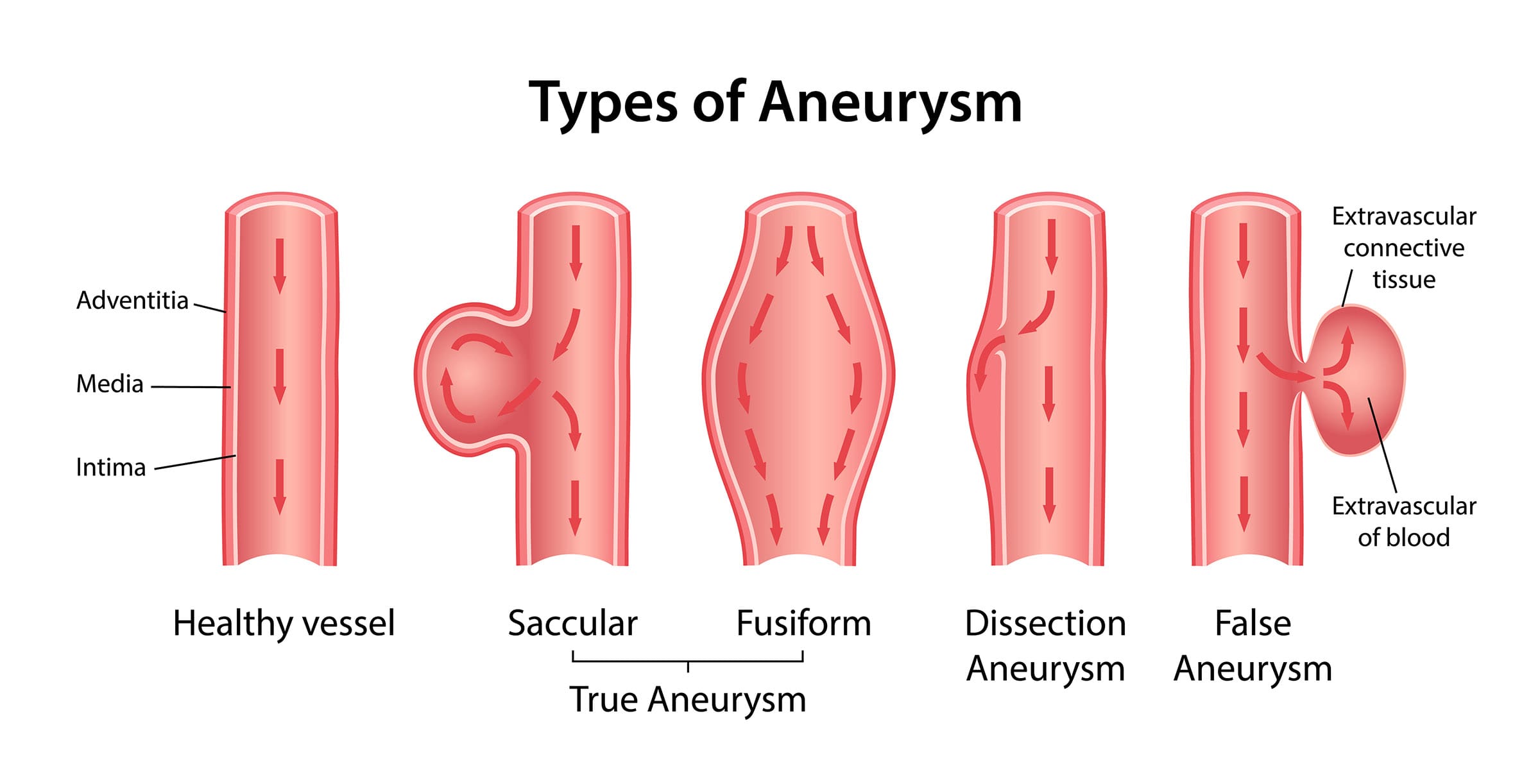
Aortic Aneurysms
An aortic aneurysm is a localised dilatation of the aorta, the largest blood vessel in the body.
The most common sites are in the abdomen and chest. In the abdomen, aortic aneurysms occur most commonly below the kidneys (infrarenal). If you have a thoracic aneurysm, this can increase the risk of an aortic dissection.

Generally, the size threshold where an aorta is considered aneurysmal is above 3 cm.
Like a balloon, the larger the aneurysm, the greater the risk of rupture. Major international research trials and national guidelines (NICE, UK) indicate that once an aneurysm reaches 5.5 cm, it is worth proceeding to a planned repair which has far better outcomes than fixing the aneurysm when it has ruptured (Operative mortality : 2-5% vs 50-75%).
There is some evidence to suggest that for women and Asian patients, this threshold should be 5 cm, due to their smaller stature compared to Caucasian male patients on which much of the research is based.
Abdominal aortic aneuryms (AAAs/’Triple A’)
This is an important condition for the following reasons:
- It has very few or no symptoms until it ruptures.
- An aortic aneurysm rupture is life-threatening or often fatal. The mortality rate from a ruptured AAA is about 75%. This means that three quarters of patients who have a ruptured AAA will die even if they have surgery. Many patients will not even make it to an appropriate hospital to have intervention, especially in city areas with traffic congestion or rural areas.
- There are effective methods of surgical repair, both open and keyhole, for aortic aneurysms with good results if done in a planned setting.
- There is a safe, convenient and effective way to detect AAAs before they rupture. This is done by a single screening ultrasound scan and a consultation with a Vascular surgeon.
- Screening has been shown in international trials to be effective in reducing AAA mortality.
In South East Asia, the prevalence (number of cases in the population) of abdominal aortic aneurysms is 0.72%. This means that in a population of 34 million, of which 55% are adults, there are about 135 000 to 226 000 Malaysians who have an abdominal aortic aneurysm at any one time.